How this modeling approach helps manage and utilise complex data streams.
Ever more companies struggle to manage the inflow of complex data. In the past year alone, we at DEVnet have worked with clients such as a bank, a municipal utility, and a logistics company, who all faced the same challenge: How to transform their monolithic on-premise data warehouse structure into a flexible, transparent, and scalable system.
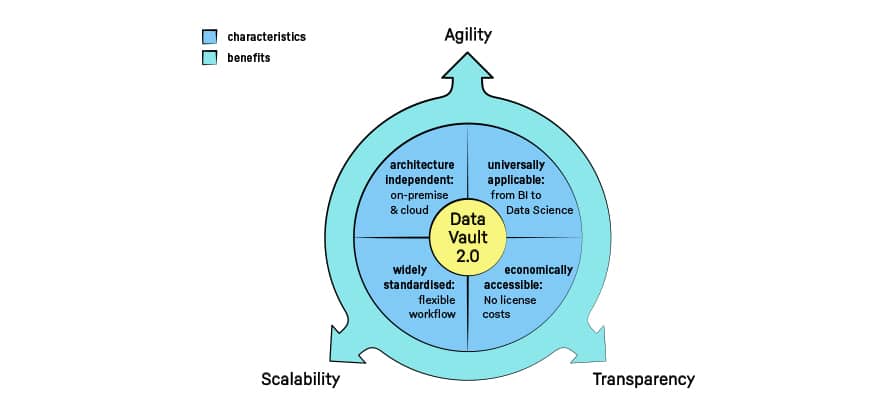
For all these projects, Data Vault 2.0 provided a solution. That is easy to explain. First, it has four attractive characteristics:
- Architecture-independent: It works in both worlds: on-premise and in the cloud – and it provides an elegant bridge to migrate legacy on-site infrastructure to hybrid solutions or to the cloud.
- Universally applicable: It supports all possible uses of Data Analytics, from Business Intelligence to Data Science and AI.
- Widely standardised: Its approach is based on standard procedures, like breaking data into predefined components in hubs, links, and satellites. That makes projects flexible and open for new developers.
- Economically accessible: It’s not an expensive proprietary tool. It’s simply a methodology to model data and therefore vendor-independent, without any extra licence costs.
Second, it brings three key benefits:
- Agility: Its design makes it easy to incorporate new data streams, business rules, models, or surrounding systems without having to refactor code. That brings flexibility and a good setup for agile-driven projects.
- Transparency: Its standardised processes, driven by metadata, facilitate tracing data from source through modifications to the current state. That improves data quality, data lineage, and auditability.
- Scalability: Its hub-and-spoke structure facilitates distributed computing and bringing developers into running projects. Plus, parallel loading allows simultaneous loads from multiple sources to boost performance.
Besides these features inherent in Data Vault 2.0, there is a final advantage that we bring: We developed our own framework to automatically generate code, which we provide to our customers. That allows us to kick-start projects with high development speed and to concentrate on crucial creative tasks in setting up data-driven environments with our clients.